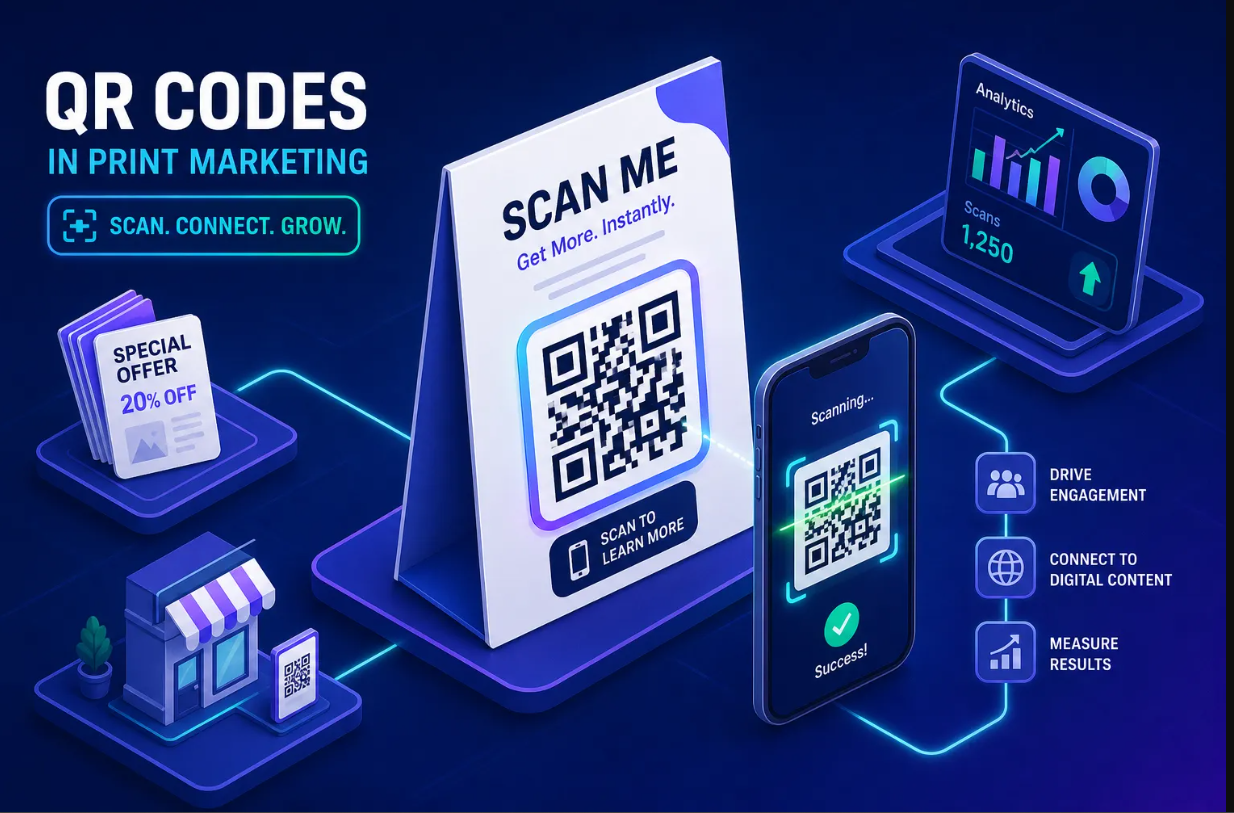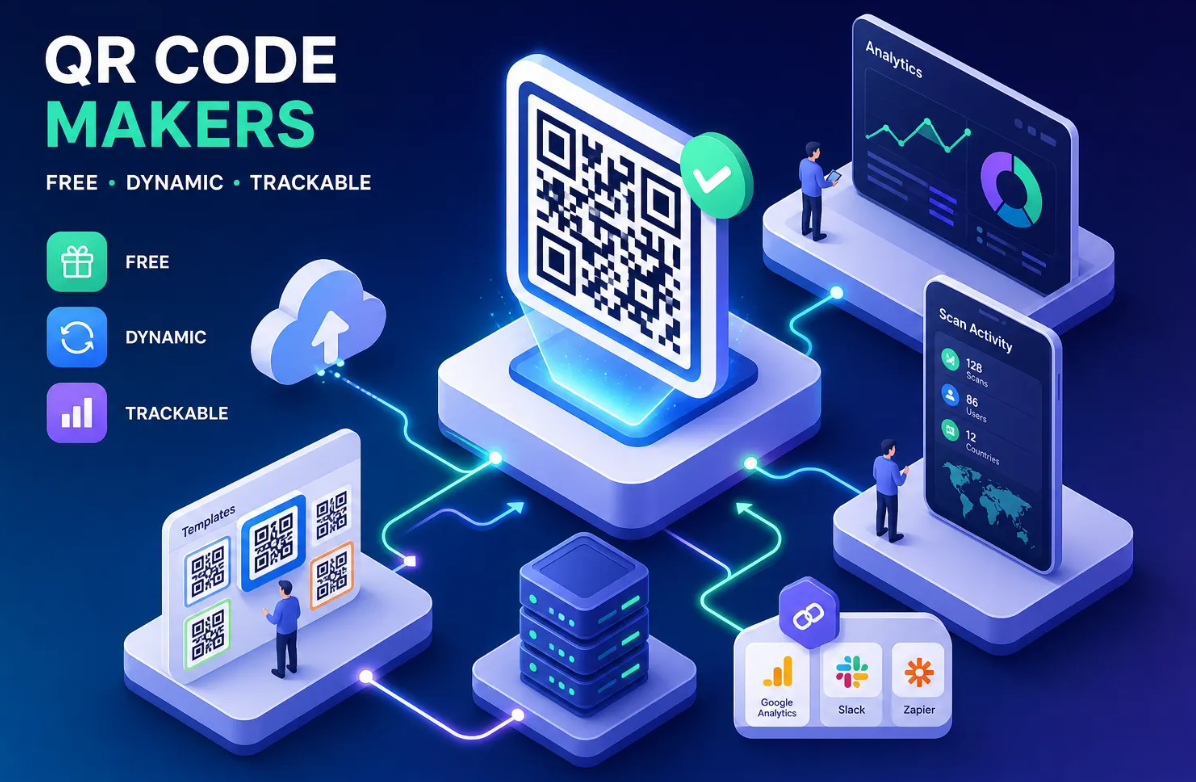




About 102.6 million U.S. smartphone users will scan a QR code in 2026, and a 2024 survey found that 68% of American adults had already used one in the prior year. For small businesses, that represents a real, low-cost bridge between the physical world and your digital presence, and many local owners have yet to take full advantage of it. QR code advertising for small business owners is one of the most underused tools in local marketing today.
The pattern is familiar: you generate a free QR code online, drop it on a flyer or menu, and move on. No tracking. No way to know if 2 people scanned it or 200. No ability to update the destination when the promotion changes. That's not a QR code strategy. That's a missed opportunity printed on cardstock.
This guide covers everything that actually matters for QR code advertising: how to choose the right code type, design it so it scans reliably in print, place it where customers have a reason to stop, and track results so you can measure what's working. By the end, you'll have a framework you can put into action this week, using one tool instead of five.
Static vs. dynamic QR codes: the decision that changes everything
Before you generate a single code, you need to understand the fundamental difference between the two types. Getting this wrong means printing hundreds of materials with a code you can never update or track.
Why static codes don't work for real campaigns
Static QR codes bake the destination URL directly into the pattern. Once printed, the destination is permanent. If your promo ends, the menu page moves, or you realize you linked to the wrong page, the code goes dead. There's no scan data, no click count, no way to know if anyone engaged with it at all.
Static codes are fine for permanent, unchanging information like a Wi-Fi password card or a fixed address. For anything campaign-related, they're a liability.
What dynamic QR codes actually unlock
Dynamic codes encode a short redirect link instead of the final URL. That means you can change the destination after printing, without touching the physical materials. More importantly, every scan generates data: total scans, unique scans, time of day, geographic location, and device type.
Because they hold a compact short link, dynamic codes also stay clean and scannable even when the final destination URL is long. That compact structure improves scan reliability on small print like table tents and packaging labels.
What you'll pay and what you get
Static codes are free from most generators. Dynamic codes typically run between $5 and $100 per month depending on the platform and feature set. Frame that cost against the alternative: running a seasonal flyer campaign with no idea whether 3 people or 300 people scanned it.
For campaigns where you need tracking or the ability to change destinations, dynamic codes are strongly recommended, and for most small business QR code marketing efforts, that covers nearly every real use case.
QR code advertising for small business: design and print rules that determine if your code actually scans
.png)
A QR code can look perfect on a screen and fail completely in print. The difference comes down to a handful of production details that most people skip over entirely.
Size, contrast, and quiet zone: the non-negotiables
Use the 10:1 rule for sizing: the code's width should be roughly one-tenth of the expected scanning distance. For a table tent scanned from 15 inches away, 1.5 inches works. For a window cling scanned from 3 to 4 feet, aim for at least 3 to 4 inches. On a standard 8.5 × 11 flyer, a minimum of 1 to 1.5 inches square is your floor.
Always print dark on a light background and leave at least 4 modules of clear margin (called the quiet zone) on all sides. Print at 300+ DPI and export from a vector file (SVG) rather than a compressed JPEG to keep the pattern edges sharp.
Adding your logo without breaking the scan
Embedding a logo in the center of a QR code is common, but it has strict limits. Keep the logo to no more than 15 to 20% of the total QR code area, and generate the code with error correction set to level H, which provides the highest recovery capability. Never place the logo over the three corner finder patterns, those square markers in three of the four corners. Test every customized code with multiple phones before sending anything to print.
The one line of text that lifts scan rates
A QR code with no context gets ignored. Adding a short instruction near the code, something like "Scan to save 15%" or "Scan to see today's menu", tells the customer exactly why to point their camera. Research and industry best practices consistently point to this small addition as an engagement booster in restaurant and retail settings. Don't assume people know what the code does.
Where to place QR codes for the highest scan rates
Placement is about meeting a customer at a moment of intent. Restaurant table tents see scan rates between 40% and 90% because the customer is seated, waiting, and already thinking about food. A sidewalk sign has a much narrower window. The best placements share a common trait: the customer has a reason to pause.
Flyers and direct mail
A flyer works when the QR code has a single, high-value purpose tied to that piece. A grand opening flyer should link to a map and hours page, not the homepage. A discount mailer should link directly to the offer. Place the code at the lower-right or center-bottom of the design, where the eye naturally finishes reading. Never fold the code. Even a single crease distorts the pattern and makes it unreliable.
In-store menus and signage
Menus and table cards are the highest-performing QR placements for restaurants. The destination should be a mobile-optimized page, not a PDF, because PDFs require pinching and zooming on a phone. For retail signage, place codes at eye level near the relevant product, not at the bottom of a display where they compete with clutter and get missed.
Product packaging and storefronts
Packaging QR codes work well for reorder pages, loyalty signups, and "learn more" product content. Back panels outperform front panels because customers read them after purchase, when their attention is focused and the product is already in hand. For storefronts, a window cling with a Wi-Fi join code or after-hours menu link keeps the code working even when the store is closed.
Three QR code campaign ideas ready to launch this week
Each format below includes specific benchmarks so you can set realistic expectations before launch. Pick the one that fits your business model and follow the structure directly.
Discount and loyalty enrollment campaign
Print a dynamic QR code on receipts, bags, or counter cards that links to a simple sign-up page: enter your email for 15% off your next visit. This builds your email list and drives return visits in a single step. Retail placements at checkout see post-scan conversion rates of 6% to 18% because intent is highest right after a purchase. Dynamic codes mean you can update the offer monthly without touching the printed materials.
Review generation campaign
Restaurants and service businesses consistently benefit from a QR code on the table, receipt, or a follow-up card that links directly to the Google Business review page. Keep the landing page simple: one clear ask, no distractions. Local restaurants running this approach can see post-scan conversion rates of 10% to 20%, which compounds quickly into a stronger review profile over just a few weeks.
Email list-building campaign via a landing page
A QR code on packaging or a flyer that links to a mobile-first landing page with an email opt-in form is a natural fit for product businesses. Keep the form short, two fields at most, and pair it with a lead magnet relevant to the product: a recipe, a care guide, a how-to resource. The combination of a specific, useful incentive and a low-friction form is what drives signups above the baseline.
QR code advertising small biz tracking: know what's actually working
Scanning happens in the physical world, but the data lives in your analytics dashboard. Connecting those two things is what separates a measurable strategy from a printed decoration.
Metrics that actually tell you something useful
Dynamic QR platforms track total scans, unique scans, scan time and date, geographic location, and device type. A spike on Tuesday afternoons might confirm a weekly promotion is drawing attention. A flat scan count signals that the placement or the call-to-action needs a change. Device data tells you whether your audience skews heavily mobile, which matters when you're designing the destination page experience.
Connecting QR scans to Google Analytics with UTM parameters
Append UTM parameters to the destination URL before generating the code. A basic structure looks like this:
utm_source=flyerutm_medium=qr_codeutm_campaign=summer-promo
Keep all values lowercase because GA4 is case-sensitive, and use underscores instead of spaces. This setup maps every scan to a specific source in GA4, so you can compare a storefront QR against a mailer QR and see which drives more conversions, not just more clicks.
The QR code must contain the fully tagged URL, not the bare landing page address. Several dynamic QR platforms, including QR code generators with analytics built in, support UTM configuration directly from the dashboard, which removes the manual step entirely.
Running your whole QR strategy from one tool
Many small businesses end up with a free static generator, a separate URL shortener, and a different analytics tool, with no real way to connect them. That's multiple logins, multiple monthly subscriptions, and separate data sets for something that should live in one place.
The problem with mixing single-purpose tools
A free static generator can't be updated after printing. A separate URL shortener adds another redirect layer with its own tracking gaps. Analytics from different platforms don't communicate, so you're manually piecing together scan data and click data after every campaign. This patchwork setup works until a destination link breaks, a promotion needs a quick swap, or you try to report results to someone else.
What an all-in-one platform changes for small business owners
Binko handles QR code generation, dynamic redirects, branded short links, and built-in scan analytics from a single dashboard. You can generate a QR code with custom brand colors and an embedded logo, attach a fully trackable destination URL, and watch real-time scan data without switching between tools. The dynamic codes are fully editable after printing, so a seasonal promotion can be updated on the fly without touching the printed flyer.
For owners who want to go further, email collection forms and A/B testing are built into the platform as well. There's a free entry point with no credit card required, which means you can test the full workflow before committing to anything.
Start your QR code advertising small biz campaign this week
The decisions that matter most: choose dynamic over static for any campaign that needs tracking or flexibility, follow the design rules before anything goes to print, and place codes where your customers already have a reason to stop and engage. Set up UTM parameters from the start so your scan data connects directly to your GA4 reports. Basic campaigns can be launched with minimal technical steps, creating a UTM string and uploading a URL to a dynamic QR dashboard is well within reach for any business owner.
QR code advertising is one of the few channels where a small business can bridge the physical and digital worlds without expensive media buys or a complex tech stack. The gap between a code that sits ignored on a flyer and one that actively drives email signups, reviews, and repeat visits comes down to setup, not spend.
If you're ready to run your first real QR code campaign, start with Binko. Free to start, no credit card needed, and everything from QR generation to scan analytics lives in one dashboard, no more stitching together tools just to answer a simple question: did anyone actually scan that?
FAQ
What is QR code advertising for small business?
QR code advertising is the use of scabbable QR codes on physical marketing materials like flyers, menus, packaging, and signage to drive customers to digital destinations such as websites, review pages, or email sign-up forms. For small businesses, it bridges offline and online marketing at a low cost.
How do I create a QR code for my small business?
Use a dynamic QR code generator like Binko to create a code with custom branding, logo embedding, and built-in scan tracking. Dynamic codes let you update the destination after printing without reprinting materials.
Where should I place QR codes for the highest scan rates?
Place QR codes where customers have a reason to pause: restaurant table tents (40-90% scan rates), checkout counter cards, product packaging back panels, and receipt footers. The best placements meet customers at a moment of intent.
How do I track QR code scans?
Use dynamic QR codes with built-in analytics to track total scans, unique scans, device type, geographic location, and scan time. Add UTM parameters to the destination URL to connect scan data to Google Analytics 4 for full campaign attribution.
What is the difference between static and dynamic QR codes?
Static QR codes encode the destination URL permanently and cannot be tracked or updated. Dynamic QR codes use a redirect link that can be changed after printing and records every scan with device, location, and time data.
Can I add my logo to a QR code?
Yes, but keep the logo under 15-20% of the QR code area and use error correction level H. Never cover the three corner finder patterns. Always test customized codes with multiple phones before printing.
How much does QR code advertising cost?
Static QR codes are free. Dynamic QR codes with analytics typically cost $5-$100 per month depending on features. Binko offers dynamic QR codes with tracking on its free plan, making it accessible for small businesses on a budget.
How do I connect QR code scans to Google Analytics?
Add UTM parameters to the destination URL before generating the QR code. Use utm_source=flyer, utm_medium=qr_code, and utm_campaign=campaign-name. This maps every scan to a specific source in GA4 so you can measure conversions, not just clicks.